
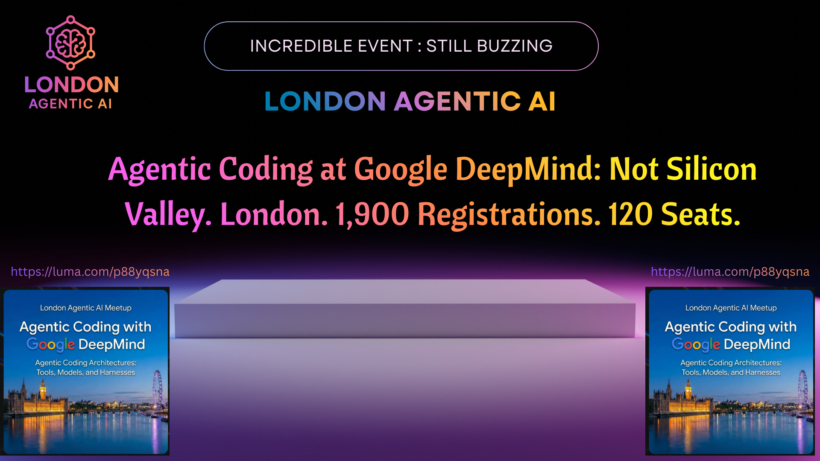
It’s more than a week now but still buzzing, On 5th February 2026, London Agentic AI hosted one of its most ambitious meetups so far: Agentic Coding at Google DeepMind. The response was unprecedented.
We received 1,900 registrations on Luma for an event with a strict venue capacity of approximately 120 attendees. Even after extending standing capacity to the maximum allowed by the venue, we were only able to accommodate a small fraction of the demand. It was a technical meetup focused on Agentic Coding architectures, evaluation systems, tooling, and production challenges.
What We Covered
The focus of the meetup was Agentic Coding as an engineering discipline. The talks explored how agent based coding systems are structured inside Google DeepMind, great demos of all the Google Agentic Coding products by Ian and later amazing talk by Ricardo on Spec Driven Development
The panel discussion went deep into topics such as evaluation strategies, system reliability, and architectural tradeoffs. The audience questions were highly technical and reflected real implementation experience rather than casual curiosity. The panel discussion really challenged the panelists from Google DeepMind and AWS and they loved it a lot. Here is snapshot of the event
The 1,900 Registration Signal
The most important takeaway from this event is not the attendance number. It is the demand signal. 1,900 registrations for a highly technical event suggests three things:
-
There is strong appetite in London for serious Agent Engineering discussions.
-
Builders are looking for depth rather than surface level AI content.
-
The community is ready to move beyond experimentation into structured engineering practices.
Agentic AI is no longer just about prompt design or chaining APIs. The conversation is shifting toward system architecture, evaluation harnesses, optimization loops, governance, and production readiness.
The demand for this meetup confirms that London has a growing base of engineers working on exactly these problems. My LinkedIn Feed went crazy with positive feedback from lot of people.
Managing Capacity, Fair Access and Gender balance
Due to strict security and capacity requirements at the venue, attendance was limited to approximately 120 people. Final approval was handled through Luma registration to ensure fairness and compliance with entry requirements. We understand that many who registered were unable to attend. With over 1,600 people remaining on pending approval, it was simply not possible to accommodate everyone safely. We are actively exploring larger venues and streaming options for future events to ensure broader access. The level of interest has made it clear that capacity planning must evolve alongside the community. There was great gender balance at the event.
Gratitude to Google DeepMind and the Speakers
We are extremely grateful to Google DeepMind for hosting this event and supporting a technically focused discussion on Agentic Coding.A sincere thank you as well to all speakers and panelists who shared practical experience rather than polished slides. The quality of content and audience interaction is what defines this community.
Future of Agentic AI events in London
London Agentic AI started only a few months ago. In that short time, it has grown into one of the most technically focused Agentic AI communities in the UK. The response to this event demonstrates that London has both the talent and the appetite for deeper conversations around Agent Engineering. There is clear demand for:
• Larger technical gatherings
• Cross lab and cross industry discussions
• Practical implementation case studies
• Evaluation and optimization frameworks
• Serious architectural thinking around agent systems
We remain committed to keeping this community builder first and technically rigorous. The interest shown in this meetup is not just encouraging. It is a strong signal that London is becoming a serious hub for Agent Engineering. More events are coming. Larger venues are being explored. The goal remains the same: real builders, real systems, real discussions. Thank you to everyone who registered, attended, supported, and contributed.