
If you build agents, you already know the feeling: the model is smarter than ever, yet your agent still flakes on long tasks, loses context, or ships brittle code. The missing piece isn’t a better model. It’s the harness.
What Is Harness Engineering (and Why Agent = Model + Harness) Think of the harness as everything around the LLM that turns raw intelligence into a reliable, autonomous coding agent: planning loops, memory systems, tool orchestration, verification, error recovery, execution runtime, and guardrails. In short: Agent = Model + Harness. The model provides the brain. The harness is the body, nervous system, and safety rails. Harness engineering is the discipline of designing and optimizing that critical layer.
The Evolution of Agent Engineering: From Prompts to Frameworks to Harnesses A year ago the conversation in agent engineering was all about prompt engineering. Then came frameworks like LangChain that gave us building blocks.
Those helped, but production-grade coding agents still felt fragile. Builders soon realized the real leverage in agent engineering isn’t in swapping models or tweaking prompts, it’s in engineering the entire runtime layer that keeps agents alive and reliable for hours (or days) on complex tasks.
That discipline, harness engineering, has quietly become the highest-leverage area in agent engineering.
Why Harness Engineering Is Exploding Right Now in Agent Engineering As frontier models improve, the bottleneck in agent engineering has clearly shifted. The biggest performance gains now come from how agents are orchestrated, evaluated, and controlled, not just the underlying model.
Recent breakthroughs show that a well-designed harness on the same model can create massive deltas, often outperforming model upgrades alone. This shift has made harness engineering one of the most critical and exciting topics in agent engineering today.
Meta-Harness: Letting Agents Autonomously Optimize Their Own Scaffolding Just days ago, Yoonho Lee and collaborators from Stanford released Meta-Harness, which lets an LLM autonomously optimize the entire harness end-to-end.
The breakthrough: instead of summaries or scalar scores, the optimizer agent gets access to the full raw history code, logs, execution traces, and scores up to 10 million tokens. It reads real failure patterns, forms hypotheses, rewrites the harness, tests it, and iterates.
Early results are impressive: it topped TerminalBench-2 coding benchmarks with Claude Haiku and delivered strong gains on classification and math reasoning tasks while using significantly fewer tokens. On X, engineers are calling it a game-changer for solving long-horizon credit assignment in agent engineering.
Natural-Language Agent Harnesses (NLAHs): Making Control Logic Readable and Portable Around the same time, researchers from Tsinghua and HIT introduced Natural-Language Agent Harnesses (NLAHs).
Instead of burying harness logic in messy controller code, they propose expressing the entire control behavior, roles, stages, state semantics, failure modes, and contracts, in editable natural language. This is paired with an Intelligent Harness Runtime that executes these specs reliably.
The excitement on X centers on making harnesses in agent engineering portable, versionable, comparable, and scientifically analyzable, moving away from black-box implementations.
What Builders Are Saying on X About the Harness Revolution The sentiment is loud and clear:
- “The harness is the new moat.”
- “Model + Harness now matters more than Model only.”
- “Harness engineering is the next big opportunity most people will miss.”
- “Every failure is a signal about what the environment needs.”
Builders are realizing that in agent engineering, mastering the harness layer delivers faster and more reliable wins than chasing the next model release.
What’s Next for Harness Engineering in Agent Engineering We’re likely heading toward self-assembling and self-optimizing harnesses, natural-language harnesses as the standard way to specify behavior, and standardized runtimes that let teams share and benchmark harnesses the same way we do with models today.
The teams investing in harness engineering now will have a serious advantage as agent engineering matures.
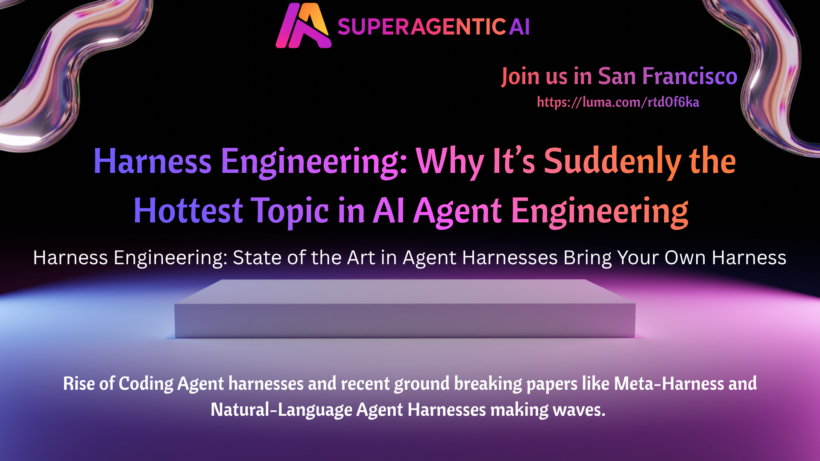
Join the Conversation: SF Meetup on Harness Engineering Want to dive deeper with other engineers building in this space?
We’re hosting the inaugural San Francisco meetup dedicated to this topic:
Harness Engineering: State of the Art in Agent Harnesses Bring Your Own Harness
Wednesday, May 21, 2026 5:30 – 8:30 PM PT (pending confirmation)
Two technical talks + focused panel with engineers working on coding agent harnesses.
RSVP here → https://luma.com/rtd0f6ka
Space is limited. Whether you’re deep in harness design or just realizing this is the layer that actually matters in agent engineering, come ready to learn and discuss.
The era of “just prompt better” is over. The era of serious Harness Engineering in agent engineering has begun.
See Y0u in San Francisco!