
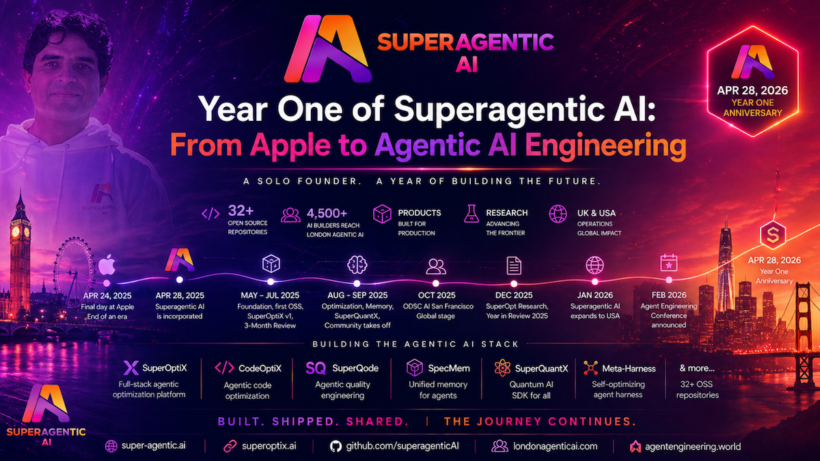
Today, April 28 2026, marks the first anniversary of Superagentic AI. One year ago, on April 28 2025, Superagentic AI was officially incorporated. A few days before that, I had completed my final day at Apple (24 April) after nearly six years. What began as a deeply personal transition from a stable and meaningful chapter at Apple has become a full stack Agentic AI company operating across the United Kingdom and the United States.
This post is a reflection on that first year. It is also a record of what can be built by a solo founder with conviction, technical focus, open source discipline, and a clear belief that the future of software will be shaped by agents, optimization, memory, protocols, evaluation, and real engineering systems.
Superagentic AI was not started as a polished corporate idea or not based on the popular OSS library with massive users. It began as a founder led experiment that prepare myself for next decade of the technical revolutions. It began with years of developer experience, and a belief that Agentic AI needed more than demos. It needed engineering discipline and solid future-proof technologies that sit on top of 5 basic pillars of the Superagentic AI. The five core pillars of the Superagentic AI are Agent Engineering, Agent Experience, Agentic DevOps, Quantum AI and Agentic Co-Intelligence.
One year later, Superagentic AI has grown into a company with products, open source projects, research initiatives, community programs, technical writing, podcasts, events, and a growing movement around Agent Engineering and helping clients to build tools and frameworks to support their journey.
The Origin: From Apple to Superagentic AI
The story started with a decision to leave Apple and begin a new chapter. After nearly six years at Apple, I wrote the founding post, Life 3.0: Goodbye Apple. Welcome Superagentic AI. That post captured the emotional and professional transition from working on Developer Experience at Apple to starting a company focused on the next generation of intelligent software systems.
Apple shaped the way I think about systems, quality, developer workflows, experience, and long term engineering discipline. That background became central to Superagentic AI . The idea was not how humans experience software nor how developer experience software. It was how agents experience software, the blog post on Agent Experience from May 2025 suggest that Superagentic AI was thinking ways ahead of this than industry is realising now. It was hugely inspired by the Netlify’s Agent Experience ideas. That was the beginning of Agent Experience.
At Apple, I worked at Developer Experience team building tools and frameworks for the internal Apple developers working on Xcode, iOS, macOS, tvOS and watchOS SDKs. Developer Experience has been one of the most important disciplines in modern software. It helps humans build, test, ship, and operate software effectively. But agents introduce a new requirement. Agents do not use software in the same way humans do. They do not browse, scroll, or click in the same way. They operate through structure, intent, memory, tools, context, constraints, and feedback loops.
Superagentic AI was created around the belief that future systems must be designed not only for developers, but also for agents. Agents need environments they can understand. They need protocols they can follow. They need memory they can retrieve from. They need tools they can use safely. They need evaluations that can measure their behavior. They need optimization loops that can improve their performance.
This was the shift from Developer Experience to Agent Experience.
Year 2025: Four Months at Apple, Eight Months Building Superagentic AI
2025 was not a normal year. It was a transition year.The first four months were spent at Apple, reflecting deeply on the future of software, the rise of AI agents, and the kind of work worth dedicating the next decade to. Leaving Apple was not an impulsive decision. It involved reflection, family discussions, financial planning, and honest self questioning. On April 24 2025, I completed my final day at Apple. On April 28 2025, Superagentic AI officially began. From that moment, the rest of the year became an intense experiment in building, learning, failing, restarting, writing, shipping, and trusting conviction. It was the beginning of a company of one, but it was never a small ambition. The mission was to build the infrastructure, tools, research, and community needed for the Agentic AI era.
The Thesis: Agent Engineering and Agent Experience are the Missing Discipline
Superagentic AI was built around one central thesis: the agentic era needs engineering discipline started with DSPy’s ideas and concepts and built agent frameworks and evolved later as technology shaped the AI. Large language models are powerful, but they are not enough by themselves. Prompting is useful, but prompting alone is not enough. Context is important, but context alone is not enough. A framework can help, but a framework alone is not enough.
Production grade agents require a complete engineering stack. They need prompt engineering, context engineering, harness engineering, eval engineering, memory engineering, skills engineering, guardrail engineering, inference engineering, orchestration, observability, and optimization. This is what Superagentic AI calls Agent Engineering.
Agent Engineering is the discipline of designing, building, evaluating, optimizing, and operating reliable agentic systems. It is about moving agents from prototypes to production. It is about creating systems that can be tested, observed, improved, and trusted.
From day one, Superagentic AI focused on making Agentic AI production-worthy. The company was not created to chase short term hype. It was created to build for the deeper infrastructure layer of the agentic future. One important thing, not to impress investors.
The Five Pillars of Superagentic AI
The company was shaped around five pillars: Agent Engineering, Agent Experience, Agentic DevOps, Agentic Co-Intelligence, and Quantum AI. These pillars were not abstract branding. They became a practical product and research map.
- Agent Engineering became the foundation for SuperOptiX, the full stack framework and optimization platform for building, evaluating, and orchestrating agents.
- Agent Experience became the philosophy behind SpecMem, AgentVectorDB, CodeOptiX, and the broader idea that systems must be understandable and operable by agents themselves.
- Agentic DevOps became the direction behind tools that help agents participate in software delivery, coding workflows, quality engineering, automation, and optimization.
- Agentic Co-Intelligence became the long term direction for collaboration between humans, agents, and multi-agent systems.
- Quantum AI became the research frontier that led to SuperQuantX, an open source step toward unifying Quantum AI development and exploring the intersection of agentic systems and quantum computing.
This structure gave Superagentic AI coherence. Every product, project, blog post, event, and research idea had to connect back to a larger thesis.
The First 90 Days: From Vision to Velocity
The first three months set the tone for everything that followed. By July 2025, Superagentic AI had already published its first major milestone update, 3 Months of Superagentic AI: From Vision to Velocity. The post captured the early execution of the company and showed how quickly the foundation had been built.
During those first 90 days, Superagentic AI launched SuperOptiX, released early open source projects, published technical blog posts, launched podcast episodes, created business focused agentic solutions, and started building community around London Agentic AI.
SuperOptiX was introduced as an evaluation first, optimization core, orchestration ready Agentic AI framework designed for production grade agents. It included early ideas around declarative agent design, DSPy based optimization, memory systems, orchestration, behavioral evaluation, and tiered agent architectures.
AgentSpy was introduced as a protocol first AI agent framework built around DSPy and agentic protocols. AgentVectorDB was introduced as a cognitive memory core for AI agents, designed around retrieval optimized and context rich storage.
The company also introduced early business focused solutions. These represented the first attempt to translate the technical thesis into practical offerings for organizations exploring agentic systems. These solutions helped us to get clients to work with for initial learnings. The first three months were important because they established the company’s operating model. Build quickly. Publish publicly. Open source early. Learn from builders. Improve continuously.
The Build Timeline: From Setup to Systems
The first year did not happen as one big launch. It unfolded month by month.
- May was about foundations. Superagentic AI was registered, operations were set up, legal and accounting work began, domains and trademarks were organized, and the first websites were created. At the same time, the first open source projects were released, including AgentSpy and AgentVectorDB.
- June was about turning the vision into architecture. SuperOptiX began to take shape as a DSPy powered agent framework. Early work focused on agent bricks, orchestration, optimization, and the overall structure of the platform. This was also the month when the ideas connected with the wider community through the LangChain London talk.
- July became the first major product milestone. The first version of SuperOptiX was released. GEPA became part of the optimization direction. The three month review documented the early progress across framework development, blog writing, podcasting, open source, and community building.
- August and September moved deeper into optimization, memory systems, model management, SuperSpec, RAG, GEPA, ODSC preparation, UKAI engagement, London Agentic AI, and SuperQuantX. The company was no longer only forming. It was becoming a full technical stack.
- October was full of building tools and preparing to exhibit in the ODSC AI Conference in San Francisco, we built
By the end of 2025, Superagentic AI had moved from idea to ecosystem. The work had expanded across products, research, open source, community, writing, events, and global engagement.
The Hard Problem: Agent Optimization
One of the most important lessons of the first year was strategic focus. In the beginning, it was tempting to think the world needed another agent framework. But the market was already filling with frameworks. There were many ways to build agents. The harder question was not only how to build agents. The harder question was how to make agents better. That realization shaped the direction of Superagentic AI. The deeper problem was agent optimization.
Models will continue to improve. Frameworks will continue to evolve. But teams still need ways to optimize prompts, tools, retrieval, memory, traces, workflows, execution paths, and agent behavior. They need ways to measure what works. They need ways to improve systems without constantly rebuilding them from scratch. This became the connective tissue across Superagentic AI. It shaped SuperOptiX, CodeOptiX, SuperOpt, SpecMem, AgentVectorDB, and the broader research direction. The focus moved from simply building agents to optimizing agents.
SuperOptiX: The Flagship Platform
SuperOptiX became the flagship product of Superagentic AI.
Available at superoptix.ai, SuperOptiX is presented as a full stack Agentic AI optimization platform built around evaluation first development, optimization core architecture, and multi-agent orchestration.
The core idea was developers should be able to define agents once, use a declarative specification, and generate native pipelines for different agent frameworks. SuperOptiX is designed to support builders who want flexibility, ownership, observability, and optimization without being locked into a single framework.
SuperOptiX supports generation flows across major agent frameworks including DSPy, OpenAI Agents SDK, Claude Agent SDK, CrewAI, Google ADK, Pydantic AI, DeepAgents, and Microsoft Agent Framework.
The platform is built around SuperSpec, a YAML based declarative specification language for agents. It also connects to the wider optimization vision through GEPA, RAG, memory, context, and framework aware compilation.
SuperOptiX is not only a framework. It is a statement about how agent systems should be built. They should be evaluated from the beginning. They should be optimized continuously. They should be observable. They should work across frameworks. They should be designed for real production use.
Open Source as an Operating Principle
Open source has been central to Superagentic AI from the beginning. The Superagentic AI GitHub organization at github.com/superagenticAI now shows a growing collection of public repositories focused on Agentic AI tools, frameworks, optimization, memory, Quantum AI, coding agents, and developer infrastructure. By the first anniversary, the GitHub organization showed 32 public repositories.
The portfolio includes projects such as SuperOptiX, dspy-code, SpecMem, AgentVectorDB, SuperOpt, CodeOptiX, SuperQuantX, Meta-Harness, TurboAgents, CodexOpt, Agentnetes, SuperQode, and Agent Engineering 101. These projects are connected by the same underlying thesis. Agents need memory. Agents need optimization. Agents need protocols. Agents need harnesses. Agents need observability. Agents need evaluation. Agents need tools that make production systems more reliable.
The open source work was not a side activity. It was the way Superagentic AI explored the future in public. Each repository represented a question, an experiment, a building block, or a product seed for the agentic era.
This is part of the solo founder spirit behind Superagentic AI. A solo founder cannot outnumber larger teams, but can outlearn, outship, outfocus, and build in public with speed and clarity.
Agentic Coding as the Operating System
Superagentic AI was building tools for agents but also built with agents. From early websites to frameworks, command line tools, integrations, documentation, research prototypes, and community assets, agentic coding became part of the company’s operating system. Working hands on with modern coding agents, AI powered IDEs, command line tools, and automation workflows revealed the strengths and weaknesses of the current agentic coding ecosystem. It also shaped the product direction directly.
This practical experience informed SuperOptiX, CodeOptiX, SpecMem, SuperQode, Meta-Harness, and the broader focus on harness engineering, evaluation, memory, and optimization. Superagentic AI was using agentic coding every day to build the company itself.
Research: SuperOpt and Agentic Environment Optimization
A major milestone in the first year was the release of SuperOpt. SuperOpt represents the research direction of Superagentic AI. The project focuses on Agentic Environment Optimization, which treats the agent environment as the object of optimization. Instead of focusing only on model weights, SuperOpt asks how prompts, tools, retrieval, memory, and traces can be optimized together as one system. This is an important shift. Much of the AI industry remains model centric. SuperOpt is environment centric. The SuperOpt announcement, Introducing SuperOpt: Research on Agentic Environment Optimization for Autonomous AI Agents, explains this direction in more detail. The research direction connects directly to the broader Superagentic AI philosophy. Agents are not just calls to a model. Agents are systems. They contain tools, prompts, context, memory, traces, policies, workflows, and feedback loops. If the environment around the model is weak, the agent remains unreliable. If the environment is optimized, the same model can often perform better. SuperOpt is therefore more than a research project. It is a statement about where the next layer of progress in AI systems may come from.
Quantum AI: SuperQuantX and the Frontier Beyond Classical Agents
The first year also included the launch of SuperQuantX. SuperQuantX was introduced as an open source SDK designed to unify Quantum AI development and provide a practical foundation for exploring the intersection of agentic systems and quantum computing. The launch post, Introducing SuperQuantX, explains the motivation behind building a unified SDK for Quantum AI development. This work sits under the Quantum AI pillar of Superagentic AI. It is early, exploratory, and research oriented. But it matters because it reflects the long term direction of the company. The immediate focus is Agent Engineering, optimization, memory, observability, protocols, and production systems. The longer term frontier includes the intersection of agents and quantum computing. SuperQuantX gives that frontier a practical starting point.
Content as a Product
Superagentic AI was built in public through writing. The founder blog at shashikantjagtap.net became active again after years of silence. The company blog at super-agentic.ai/resources/super-posts became the home for Superagentic AI updates, product announcements, research notes, and technical articles. By the first three months, Superagentic AI had already published sixteen blog posts and launched podcast episodes covering DSPy, multi-agent orchestration, memory systems, and related topics.By the end of 2025, the year in review post, Year in Review 2025: From Apple to Superagentic AI, Building an Agentic Company of One, reflected on eight months of building, learning, experimenting, and committing to a direction that could matter for years.The writing covered Agent Engineering, Agent Experience, Context Engineering, memory, observability, optimization, GEPA, SuperSpec, SuperOptiX, local models, agent protocols, coding agents, SuperOpt, SuperQuantX, and more. This content became public research notes, product education, technical documentation, community building, and a record of how the company’s thinking evolved over time.
London Agentic AI: From Community Idea to Builder Movement
One of the most meaningful achievements of year one was the creation and growth of London Agentic AI. London Agentic AI was formed on April 25 2025, just before Superagentic AI was incorporated. The community was created as a highly technical, vendor neutral space for AI engineers, agent builders, researchers, founders, and technical leaders working on production grade agent systems. The community website at londonagenticai.com describes London Agentic AI as a serious builder community focused on Agentic AI Engineering end to end, including prompts, context, MCP, tools, coding agents, evals, memory, harnesses, guardrails, inference, observability, and safe adoption. By the first anniversary, London Agentic AI reported more than 4,500 AI builder reach and curated technical rooms of 100 to 150 people.
The community also introduced the Agent Lines curriculum, a London inspired map of the Agentic AI Engineering stack. The lines include Prompt Line, Context Line, Harness Line, Eval Line, Memory Line, Skills and Tools Line, Guardrails Line, Inference Line, Protocol Line, AgentOps Line, Coding Agents Line, Orchestration Line, Agent Experience Line, Safe Adoption Line, Observability Line, and Optimization Line.
London Agentic AI matters because it turns the company’s thesis into a shared conversation. Agent Engineering is not only a product category. It is an emerging practice. The best way to define that practice is by bringing builders together and creating space for serious implementation discussions.
Events, Conferences, and Global Engagement
Superagentic AI’s first year was not limited to writing and code. It also included in person events, speaking engagements, community building, and international exposure. The early months included a LangGraph talk at a LangChain hosted London event, participation in London Tech Week, the launch of London Agentic AI, and early conversations with investors, founders, and technical communities. In 2025, Superagentic AI also participated in ODSC AI San Francisco, bringing its agent optimization work to a global AI audience. The company also joined UKAI and participated in discussions around the future of AI in the United Kingdom, including engagement connected to policy, standards, infrastructure, and the Agentic AI era. These activities were important because Agent Engineering cannot be built only through code. It needs shared language, community dialogue, technical education, and trust across builders, researchers, founders, enterprises, and policy groups. Superagentic AI started from London, but the first year made the company increasingly international. The work now connects London, San Francisco, the United States, the United Kingdom, open source communities, technical meetups, and global AI practitioners.
Expanding to the United States
In early 2026, Superagentic AI expanded its operational presence to the United States. The announcement, Superagentic AI Expands to the United States of America, described the next phase of the company’s growth across London and the United States. This expansion matters because the agentic AI ecosystem is global. London is becoming an important hub for AI builders, researchers, and applied AI companies. San Francisco remains one of the most important centers for AI infrastructure, startups, research, and developer ecosystems. Superagentic AI is now positioned across both worlds. The UK and USA presence reflects the company’s ambition to contribute to Agent Engineering as a global discipline, not only as a local startup story.
Agent Engineering Conference: Turning the Thesis Into a Category
The next major step is Agent Engineering Conference. The conference website at agentengineering.world presents Agent Engineering Conference as a dedicated conference for the engineering disciplines behind Agentic AI coding. Agent Engineering Conference is designed to bring together the builders working on prompt engineering, context engineering, harness engineering, eval engineering, memory engineering, skills engineering, guardrail engineering, inference engineering, orchestration, agent optimization, agent experience, coding agents, and production grade agent systems. This conference is a natural extension of the first year of Superagentic AI. The company started by building tools. It then published research, wrote publicly, created open source projects, launched London Agentic AI, spoke at events, and helped shape the conversation around Agent Engineering. Agent Engineering Conference is the next step in turning that conversation into a recognized discipline. Year one proved the foundation. Year two is about helping the category mature.
Building Through Constraints: Solo Founder Journey
The first year was not only about launches and milestones. It also included constraints. Building as a solo founder means carrying the full weight of product, engineering, research, writing, community, marketing, operations, finance, legal, partnerships, and strategy. There is no large team to hide behind. There is no department to pass work to. Every decision, every launch, every event, every line of writing, and every product direction requires focus. There were also personal constraints. As shared in the 2025 year in review, an injury in August forced me to work from bed for several weeks. That period could have slowed everything down completely. Instead, it became a time for deep optimization work, writing, experimentation, and preparation for the next phase. That experience reinforced one of the most important lessons of the year. Building a company of one requires resilience. It requires patience. It requires the ability to keep moving even when conditions are not ideal. The solo founder journey is not romantic every day. It is intense, uncertain, and demanding. But it also creates unusual clarity. There is no room for politics. There is no room for bureaucracy. There is only the work, the mission, the users, the community, and the next meaningful thing to ship.
What Did Not Work
The first year also made one thing clear: building is only half the battle. Shipping code is hard, but explaining why the work matters can be harder. Designing an API is hard, but distribution is harder. Building a product is hard, but earning trust is harder. Writing code can be easier than building community. Creativity can be easier than focus.
As a technical founder, it is natural to keep building. But the market needs more than products. It needs clarity. It needs repetition. It needs education. It needs examples. It needs proof that the category matters. This was one of the most important lessons of year one. Superagentic AI did not only need to build tools. It needed to explain Agent Engineering, educate builders, support communities, and show why optimization, memory, evals, observability, and harnesses are central to the future of agents.
The Solo Founder Spirit : One Person, $x Dollar Company
The first year of Superagentic AI is also a story about what a solo founder can build in the agentic era. A solo founder can register a company, build products, launch open source projects, publish technical research, create a community, host events, speak at conferences, write long form technical content, launch podcasts, build websites, explore global partnerships, and define a category. That does not mean it is easy. It means the tools have changed. AI assisted development, agentic coding, open source, public writing, automation, and community led growth allow one focused builder to move with a level of velocity that would have been much harder a few years ago. Superagentic AI is not proof that teams do not matter. Teams matter deeply. But year one is proof that a solo founder with a clear mission can build the foundation for something meaningful before a large team exists. The solo founder spirit is not about doing everything alone forever. It is about starting with ownership, speed, clarity, and conviction. It is about proving the thesis before asking others to believe in it. It is about turning personal risk into public momentum. That spirit defined the first year of Superagentic AI.
What Was Achieved in Year One
In one year, Superagentic AI moved across several connected dimensions. The product layer grew around SuperOptiX, CodeOptiX, SuperQode, SuperRadar, SpecMem, and related tools. The open source layer expanded into a public GitHub ecosystem with repositories covering agent frameworks, memory, optimization, Quantum AI, harnesses, orchestration, quality engineering, and developer tooling. The research layer introduced SuperOpt for Agentic Environment Optimization and SuperQuantX for Quantum AI exploration. The content layer produced technical writing, product announcements, founder reflections, and educational material across the founder blog and company blog. The community layer grew through London Agentic AI, which became a high signal builder community for Agentic AI Engineering. The events layer expanded through London meetups, technical talks, ODSC AI San Francisco, UKAI engagement, and the creation of Agent Engineering Conference. The geographic layer expanded from the United Kingdom into the United States. Together, these achievements form the real story of year one. Superagentic AI did not only build a product. It built a thesis, a product ecosystem, an open source portfolio, a research direction, a community, and a category narrative around Agent Engineering.
What Year One Taught Me
Year one taught me that agents need engineering discipline. The industry has moved beyond simple demos. Production agent systems need evals, memory, tools, context, protocols, observability, guardrails, and optimization. It taught me that optimization is the hard problem. Choosing a model matters, but optimizing the environment around the model may be just as important. Prompts, memory, tools, retrieval, traces, workflows, and execution paths all shape agent behavior. Here comes Harness Engineering and we already preparing an event in San Francisco to deal with the harness engineering. It also taught me that Agent Experience matters. Agents need systems they can understand, operate, and improve. This is not only a user experience problem. It is an infrastructure problem. In a fast moving field, public repositories, examples, documentation, and transparent experiments help builders understand what is real. Year one taught me that community creates categories. London Agentic AI proved that builders want serious, technical conversations about agents. They want to discuss evals, memory, coding agents, protocols, RAG, observability, safe adoption, and production systems. Year one taught me that a company of one can move fast, but focus is everything. Ideas are easy to generate. The hard part is choosing the right ones, finishing them, explaining them, and connecting them to a larger mission.
From Build Mode to Market Mode
The first year was intentionally build heavy. The priority was to create foundations: products, research, open source projects, content, events, and community. That foundation now exists. The next phase is different. Year two is about turning that foundation into adoption. That means deeper product development, more real world use cases, stronger partnerships, forward deployed engineering opportunities, pilot programs, continued open source releases, and a wider presence across London and San Francisco. Year one proved the foundation. Year two is about applying it with builders, teams, enterprises, researchers, and communities working on real agentic systems.
Looking Ahead: Year Two
The mission of Superagentic AI remains the same: build the infrastructure, tools, research, and community needed for the agentic era. SuperOptiX will continue to evolve as a full stack Agentic AI optimization platform and more focus on the Agent Engineering practices to includes harness engineering, memory engineering and coding agents. The open source ecosystem will continue to expand across memory, harness engineering, agent optimization, quality engineering, orchestration, and developer tools. SuperOpt and SuperQuantX will continue to represent the research frontier across Agentic Environment Optimization and Quantum AI. London Agentic AI will continue to serve builders in the United Kingdom. Agent Engineering Conference will bring the discipline together in London and San Francisco. It’s taking long to grab sponsors but will get there.
The United States expansion will help Superagentic AI connect more deeply with the global AI builder ecosystem. We will be working with ore US based clients in this year.The long term ambition is clear. Superagentic AI wants to help make Agent Engineering a real discipline, not just a phrase. It wants to help developers, researchers, founders, and enterprises build agent systems that are reliable, observable, optimized, and ready for production.
Thank You, All.
Thank you to everyone who has followed, supported, attended, spoken, sponsored, contributed, read, listened, starred a repository, shared feedback, or believed in the mission. Thank you to the London Agentic AI community for showing that serious builders want serious technical conversations. Thank you to the open source community for exploring, testing, and sharing ideas. Thank you to every founder, researcher, engineer, investor, speaker, sponsor, and friend who helped shape this first year.
Thanks You all the companies where I get chance to interact with so far and especially StackOne to gave us an opportunity to build with them. Superagentic AI began as a leap from Apple into the unknown.
One year later, it has become a full stack Agentic AI company, an open source ecosystem, a research lab, a community builder, and a growing voice for Agent Engineering. The agentic era is no longer a future prediction. It is being built now.
Year one was the foundation. Year two is where Agent Engineering moves from idea to discipline.
Key Resources
Company: https://super-agentic.ai
SuperOptiX: https://superoptix.ai
London Agentic AI: https://londonagenticai.com
Agent Engineering Conference: https://agentengineering.world
Open Source: https://github.com/superagenticAI
Founder Blog: https://shashikantjagtap.net
Founding Post: Life 3.0: Goodbye Apple. Welcome Superagentic AI
Three Month Update: 3 Months of Superagentic AI: From Vision to Velocity
2025 Review: Year in Review 2025: From Apple to Superagentic AI, Building an Agentic Company of One
SuperOpt Research: Introducing SuperOpt: Research on Agentic Environment Optimization for Autonomous AI Agents
SuperQuantX: Introducing SuperQuantX