
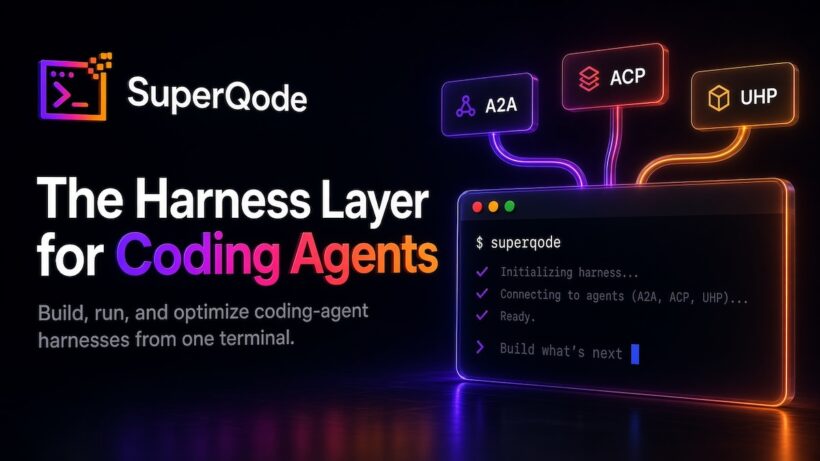
Today we are announcing SuperQode v2, the harness interoperability layer for coding agents. It is Apache-2.0, installs in one line, and leads with full Agent2Agent support, a hosted A2A agent anyone can call, and API keys for teams who want to try it against their own systems.
How we got here
We started SuperQode in January with a different goal, and launched v1 on Product Hunt that month. The plan was a software factory: agents covering the roles a software team actually has, including quality engineering and development engineering, working the whole delivery path instead of one step of it. The market moved underneath that plan. Coding agents multiplied through the first half of the year, and the decision that mattered stopped being which model to use. It became which coding agent harness to run your workflow on. Every harness carries a different set of tradeoffs in context handling, tool surface, permissions, memory and cost, and those tradeoffs decide whether a task completes or burns tokens and ships nothing.
SuperQode already supported a wide range of models, so optimizing the harness around them was the new ground.
We found the MetaHarness work out of Stanford, built evaluation and optimization on top of it, and published our own metaharness Python package so the same techniques could run around SuperQode and outside it. Two things were clear by then: Anthropic and OpenAI had captured coding agents for development with harnesses already adopted by a large number of teams, and other companies were shipping harnesses of their own under open, closed and hybrid licences.
Building one more coding agent harness would have added nothing, so we took the metaharness approach and built the layer above them. Users get model independence and harness independence together, with the ability to switch harnesses the way they already switch models, carrying the session across the handover. We shipped that as harness independence and wrote up the reasoning.
Databricks released Omnigent a short time later, covering the same concepts with more engineers, a larger budget and far wider distribution. Our position holds on the side that harness-switching frameworks leave out, which is measurement: GEPA, MetaHarness and SkillOpt give you numbers on your own repository before you commit to a harness, and we published that comparison openly. Several companies have since launched cloud harness switching or harnesses of their own, which tells us the layer was the right place to stand.
Through all of it we kept building the parts that make the layer real: support for ACP, A2A and MCP; native harnesses, Core, RLM, PiPy, Workbench and No Tool, usable as presets or as the starting point for something you own with a single HarnessSpec file in your repository; and a Harness Hub that maps the harness market as it exists.
One harness we found genuinely interesting was Prime Agent from Prime Intellect, which gives the model a single tool and a persistent Python environment in place of a wide tool surface with filters, so we built and published the prime-agent-python-client for it.
curl -fsSL https://superqode.dev/install.sh | sh

cd your-project
superqode
Agent2Agent, in full
v2 leads with A2A. SuperQode serves a versioned harness over Agent2Agent with discovery, tasks, streaming, cancellation, subscriptions and authentication, and one published Agent Card advertises JSON-RPC and HTTP+JSON across A2A 1.0 and 0.3, so a single document registers on Gemini Enterprise, Microsoft Foundry and Bedrock AgentCore.
The hosted agent at a2a.superqode.dev is live and open, and it scores 100% of MUST requirements and 100% of MAY requirements against the official A2A Technology Compatibility Kit maintained under the Linux Foundation. Ask it which coding agent or harness fits a set of constraints and it answers from the Harness Hub with licence and setup detail attached. Signed API keys carry a customer, a tier and an expiry for teams who want a keyed connection, and a remote deployment serves that shortlist alone by default, so no repository leaves your machine.
As a client, SuperQode reads OAuth, device code, client credentials, mutual TLS and API key schemes from the card, and ships an inspector and a conformance pack for debugging an integration you do not control.
Use it as a coding agent
SuperQode is a coding agent in its own right, in the terminal and from the command line, with a headless mode for CI. Sessions are durable and support compaction, forking, resume and a session tree. Approvals and permissions are policy, and execution runs on the local OS or in Docker, Podman, E2B, Daytona, Modal or Vercel sandboxes. For work that spans several harnesses, WorkOrders give dependency-aware tasks isolated worktrees, bounded workers, crash recovery, acceptance checks and an explicit human decision before delivery.
Watch the demo:
Unified Harness Protocol
SuperQode speaks UHP as a client, so a harness hosted by the HarnessRouter team or by your own platform behaves like a local one. Discovery lists what a server advertises, the harness you select joins the switcher and the Hub, and its work returns through the same session, event and evidence model. Every submission carries an idempotency key so a retry cannot start a second agent in the same workspace, every request declares the protocol version, and a dropped stream is recovered from the authoritative response.
Agent Client Protocol
ACP has been supported from day one and now reaches 49 agents in the Hub. Codex, Claude, Copilot, Cursor, Grok, Antigravity, Prime Agent, Muse Code and Kiro connect on plans you already hold, while OpenCode, Cline, OpenHands, Kimi Code, Qwen Code, Goose, Amp, Devin, Factory, Pi and fast-agent connect with a key or a local model. The connect flow groups these by cost and licence, credentials reach the agent process alone, and an agent’s plan updates render in a pinned panel with per-task status.
Memory backends as plugins
Memory is a provider interface with implementations you select in configuration. A local store ships by default, SpecMem covers specification-driven recall, and Mem0, Cognee and Supermemory attach as optional providers. The harness declares which one it uses, so memory becomes part of the versioned artifact alongside tools and permissions, and swapping a backend leaves the rest of the spec untouched.
HarnessSpec and building your own
One HarnessSpec covers the runtime, model policy, tools, memory, search, sandbox, approvals, workflow and evidence. Start from a wizard, from a template, or from what your repository already contains, since AGENTS.md, CLAUDE.md, Cursor rules and Copilot instructions convert into an inspectable spec you own. A harness you write in Python joins the catalog with one function and one entry point, which places it in the Hub beside the commercial ones. Two checks keep a spec honest: one confirms the harness can run, and a new drift check confirms the harness that resolved is the one the spec declared, comparing the runtime, sandbox, tools, shell and write stances and evidence store, and exiting non-zero so it can gate a pipeline.
Evaluate and optimize
This is the part that stays ours. GEPA Omni generates candidates, mines failures and selects on a Pareto frontier. HarnessBench packs a manifest, a scorecard and drift checks so a result is reproducible from a different checkout. SkillOpt improves reusable skills under the same gates. Evaluation records behaviour and leaves the spec alone; candidates stay reviewable artifacts, run through a sealed held-out gate, and reach production only when you promote them.
Models, inference and the Hub
Local inference runs on Ollama, MLX, LM Studio, vLLM, SGLang, TGI, llama.cpp and DwarfStar, with an offline Airplane Mode for work that stays on the machine. Hosted routes cover Baseten, Together AI, Fireworks AI, Modal and OpenRouter alongside the major providers, through your own keys or a subscription you already pay for. The Hub now holds 104 harnesses, 64 of them open source, each with runtime, provenance, licence and setup on its own page, in the terminal and on the web, with the whole catalogue available as one JSON fetch.
Get started
Install, open a repository, and connect a harness you already use. SuperQode v2 runs on macOS, Linux and Windows through WSL2, and everything above is Apache-2.0. The product is at superqode.dev, the quick start and full documentation at docs.superqode.dev, the package on PyPI, and the source, issues and discussions at github.com/SuperagenticAI/superqode. Tell us which harness you connected and what it got wrong; that is the feedback v2 was built from.