
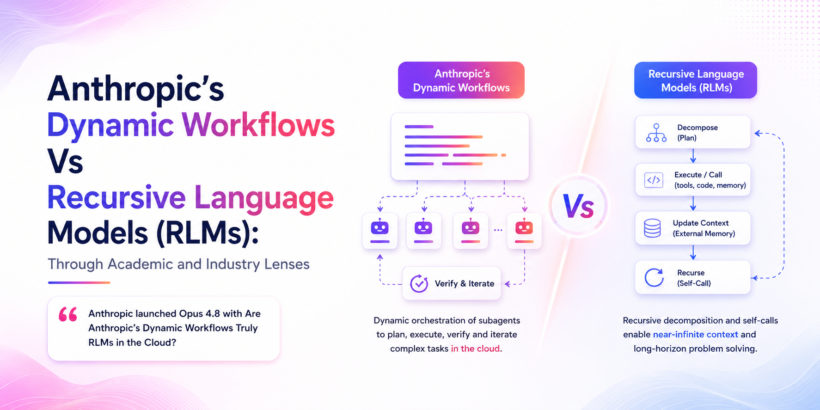
Anthropic launched Opus 4.8 with Are Anthropic’s Dynamic Workflows Truly RLMs in the Cloud?
Anthropic recently launched the Opus 4.8, the smartest model which has highly capable coding task and developers are loving. It’s coding capabilities. One of the feature they launch on top of it is the dynamic workflows. This feature is striking a debate on social media and all over the Internet that anthropic has copied the ideas from the academic paper RLM and implemented in their product. In this post, we will try to uncover was it true and what not from our angle? A detailed examination of the connections between Anthropic’s recent capabilities and foundational academic research in agentic artificial intelligence.
The artificial intelligence community continues to analyze Anthropic’s introduction of Dynamic Workflows in Claude Code, released as a research preview in May 2026. Developers have reported substantial successes using this feature on large-scale codebases through parallel subagent coordination and comprehensive end-to-end task execution. A central question in ongoing discussions concerns the relationship between Dynamic Workflows and Recursive Language Models, or RLMs, first proposed in academic research from October 2025. Professionals are evaluating whether this capability represents a practical realization of RLM principles in a production cloud environment.
This post provides a structured overview of the core concepts, their interconnections, perspectives from researchers and practitioners, early open-source contributions, and broader industry implications. It draws on recent statements to present a balanced and current assessment.
Understanding Recursive Language Models (RLMs)
Recursive Language Models were introduced in the October 2025 MIT CSAIL research by Alex Zhang and collaborators. This framework offers an inference strategy to overcome challenges in managing complex, long-horizon tasks with large language models. Conventional methods frequently attempt to incorporate all required information into a single extended prompt. Such approaches often lead to context degradation, in which model performance deteriorates as input length grows.
RLMs address this by reframing the interaction as an external REPL-style environment. The model decomposes problems programmatically, typically by generating code that enables recursive self-calls or tool invocations. Context is handled externally rather than being limited to the model’s immediate context window. This design supports scalable task decomposition while preserving efficiency and coherence. In principle, it allows for near-infinite effective context lengths by offloading information to external structures and permitting dynamic interaction with them.
Alex Zhang’s subsequent work on the Mismanaged Geniuses Hypothesis expands on these ideas. The hypothesis posits that frontier models hold considerable latent potential for specialized tasks but are often underutilized due to inadequate orchestration. Improved decomposition strategies, including those enabled by RLMs or orchestrator-subagent systems, present a promising direction. These approaches focus on training models for effective self-management, which may yield advances in length generalization, long-horizon reasoning, and handling out-of-distribution problems through structured composition rather than solely through increases in model scale.
Dynamic Workflows from Anthropic
Dynamic Workflows constitutes Anthropic’s progress in agentic capabilities within Claude Code. When a prompt includes terms such as “workflow,” the model generates an orchestration script dynamically. This script then coordinates a fleet of parallel subagents, executes tasks within the Claude Code environment, verifies outputs, and iterates as necessary to fulfill the overall goal. I tried the dynamic workflows myself and I was blown away because with one goal it’s on 80 working independently to one goal this is incredible for the developers where task has been automatically ended over by multiple agents at the same time. Dynamic workflow is incredible feature added by the cloud code team.
The feature has shown practical utility in demanding scenarios, including large-scale codebase migrations and intricate refactors. It delivers a seamless, cloud-native experience for managing extensive repositories while incorporating built-in verification. The system prioritizes reliability and scalability, enabling developers to address ambitious projects with less manual oversight. At the same time, observations indicate that it can be token-intensive when applied at scale.
Perspectives on the Relationship: Alignments and Distinctions
Researchers and practitioners have offered detailed analyses of how Dynamic Workflows relates to RLM concepts. Alex Zhang, lead author of the original RLM paper, has stated that Opus 4.8 combined with Dynamic Workflows in Claude Code represents perhaps the first instance of a frontier model being seriously trained toward RLM principles. He has noted that recent developments move the field closer to the RLM vision and has suggested that such capabilities could become the standard for nearly all coding agent interactions within a year. Zhang recommends consulting the RLM paper to appreciate the value of the underlying abstractions.
Omar Khattab, an MIT CSAIL researcher closely associated with RLM and related work, has provided specific criteria from the paper that align with the new feature. According to Khattab, an RLM requires two core elements: first, giving the underlying LLM a symbolic handle to the user prompt and the output stream; second, symbolic recursion over the prompt, which corresponds directly to what Anthropic refers to as “dynamic workflows.” Omar has remarked that Claude Code has effectively become an RLM with this release.
Many in the community characterize Dynamic Workflows as operationalizing RLM ideas in a production setting. Common descriptions include “RLM on agent harnesses” and recognition of a new scaling dimension that combines base model compute, inference-time thinking compute, and generated harness or orchestration compute. This perspective views the release as a meaningful advancement in agentic system design.
At the same time, nuanced distinctions have been highlighted. Some researchers argue that Dynamic Workflows does not fully satisfy a strict definition of RLM. For example, it may lack a fully persistent language REPL with programmatic context access beyond standard tool use. Instead, it generates an orchestration script followed by tool calls and text-based handoffs between agents, rather than direct recursive self-calls with clear return semantics in a REPL sandbox. One analysis scores the match at roughly one-third based on core criteria such as programmatic context access and persistent REPL semantics.
Additional concerns focus on recursion control. When the model itself determines when to stop recursion without external ceilings on cost or time, it may introduce new versions of longstanding challenges rather than resolving them. The original RLM paper described recursion at a depth of one, whereas Dynamic Workflows extends further, including greater control over model weights. These viewpoints position Dynamic Workflows as a valuable evolution of sub-agent orchestration rather than an exact replica, while still recognizing its conceptual overlap and practical strengths.
Timeline, Early Implementations, and Agentnetes by Superagentic AI
The progression from theory to implementation has been notably rapid. The October 2025 RLM paper was followed in December 2025 by open-source projects emerging from the Superagentic AI Vercel x DeepMind “Zero to Agent” hackathon in London. One such example is Agentnetes from Superagentic AI, aframework for self-organizing agent swarms.
Drawing from its documentation, Agentnetes applies RLM-inspired recursive decomposition by transforming a single high-level goal into an emergent team of specialist agents in isolated sandboxes. It features a root “Tech Lead” agent that explores via external tools, along with tight loops of search, analysis, planning, execution, and verification. Agents maintain minimal token footprints using basic tools and support parallelism, inter-agent collaboration, and self-healing mechanisms. This and similar early efforts demonstrated recursive, dynamic multi-agent approaches in accessible developer tools well before broader industry rollout.
Industry Patterns and the Academic-to-Product Gap
These developments illustrate a recurring pattern in artificial intelligence. Major laboratories often incorporate concepts from institutions such as MIT, Berkeley, and Stanford with a lag of approximately six to nine months. Ideas involving advanced decomposition, external context management, and dynamic multi-agent orchestration frequently originate in research papers and collaborative events before being refined into commercial products, sometimes without direct attribution to original sources.
Anthropic’s Dynamic Workflows exemplifies the effective translation of academic and early open-source insights into a scalable cloud solution. While this delivers immediate benefits to users, it also highlights the importance of the wider ecosystem of researchers and independent developers who identify and prototype foundational concepts.
Discussions around the Mismanaged Geniuses Hypothesis reinforce that meaningful progress may depend on enabling models to perform effective self-management and decomposition within well-designed scaffolds.
Is Dynamic Workflow is Really RLM in the Cloud?
This is the time to add my own hot takes on this debate, Anthropic has implemented a RLM kind of approach in the previous version when they launched the managed agent and since then they clearly indicated that they are using the concepts from RLM in their workflows and from that point it’s clear that they are investigating into the research and putting a lot of investment on the academic research after that they might have got an idea about the other alarms and the sandboxing env and that would have come to in the picture for the dynamic workplace so the ideas are similar but not exactly the same by looking at the RLM paper, it stops at depth of 1 in recursion, however Anthropic went well beyond and had a recursive agent spawning multiple of sub agents which extended the RLM concept having said that when the ideas has been implemented it is not exactly as RLMs so whatever it is Anthropic has innovated a lot on this feature and now become industry standard, On other side there are other coding agent like Codex also started investigating this kind of ideas as we noticed that in the recent Codex versions, it writing in the python code rather than running the shell commands that is the idea of from RLMs but they have not innovated that level as Anthropic. Codex team could have innovated way better because they have the same tech stack using python and their harness is well optimise the python they could have implemented this way earlier however the Claude Code being the TypeScript first framework they have ported this idea of RLMs into their product and innovation. I hope the Codex team will catch up on this one sooner than later. In the end in my opinion, concept of the RLM and Dynamic Workflow are close and very similar but differ in the implementation. In the end, execution matters.
Conclusion
The relationship between Dynamic Workflows and Recursive Language Models continues to generate constructive dialogue, with direct contributions from key researchers such as Alex Zhang and Omar Khattab. While alignments are evident and substantial, distinctions in implementation details remain subjects of thoughtful analysis. Regardless of final classification, the release clearly validates recursive and dynamic multi-agent methodologies as essential to the advancement of agentic artificial intelligence.
From academic foundations in RLM research, through pioneering open-source projects such as Agentnetes, to refined cloud implementations, the field is advancing with notable speed. This era demonstrates how academic innovation can translate rapidly into accessible and powerful tools. The central insight is that future breakthroughs will rely as much on sophisticated orchestration as on raw model intelligence.
Practitioners are encouraged to explore both the original research and current implementations, contributing to the continued refinement of agentic systems. Thoughtful perspectives on these developments are welcome.