
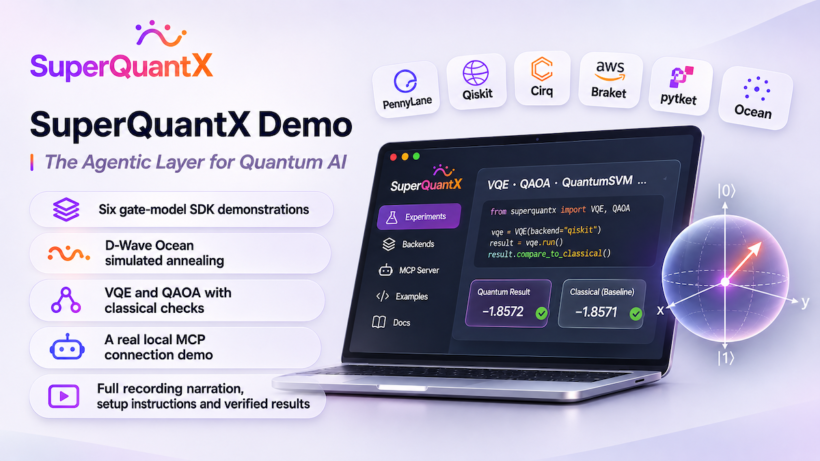
The first week of November brings a concentrated stretch of quantum gatherings to the United Kingdom, where researchers, founders, investors and public-sector leaders meet to discuss how quantum technologies move from laboratory promise into industrial practice. For Superagentic AI this is UK Quantum AI Week, and it is more than a calendar of events. It is the natural moment to put a clear stake in the ground for Quantum AI and to open SuperQuantX as a project with its own domain, website and open-source identity. SuperQuantX is the agentic layer for Quantum AI. It is an open software layer across quantum SDKs, with a classical baseline for every result. Agents, researchers and engineers can drive the same quantum experiments through one interface, and the algorithms report a classical reference beside the quantum answer so it can be judged rather than taken on faith.
We believe the UK is unusually well placed to lead in Quantum AI. The country already hosts a dense network of quantum hardware companies, software teams, university groups and national programmes that treat the field as a serious industrial opportunity rather than a distant science story. That depth of capability, together with strong public interest through Innovate UK and related initiatives, creates room for software that helps developers work across vendors instead of being locked to a single stack. We also believe Quantum AI will arrive sooner than many roadmaps imply. It will not replace classical computing overnight, but it will become one of the next frontiers of technology: hybrid systems in which agents, classical models and quantum routines share a workflow, and in which results are expected to be inspected rather than accepted on faith.
That belief is why Superagentic AI has been building SuperQuantX from early in our work. Like many teams, we have spent recent years moving quickly in AI and agentic systems, and that pace meant our Quantum AI work advanced more slowly than we originally hoped. We have not given up on Quantum AI at all. SuperQuantX is how we are putting that commitment back in the open: a dedicated project, a released Alpha, and a public site the community can inspect. Our aim is straightforward to state and demanding to execute well. We want SuperQuantX to be the agentic layer for Quantum AI: an open software layer across quantum SDKs and backends, so an experiment can travel without a full rewrite every time the underlying toolkit changes, so agents and people can work through the same documented interface, and so every quantum result arrives next to a classical baseline that can actually be judged. During Quantum AI Week we attended the Quantum + AI Tech Show at Big Penny Social in London, and we are attending the UK National Quantum Technologies Showcase 2026 at the Business Design Centre to close the week. Across these days we have already spoken with many remarkable Quantum AI companies building from the UK and across Europe. The Showcase is where we want to demonstrate what we have built, meet industry leaders in the field, and learn more about Innovate UK’s plans and investment priorities for quantum in the years ahead.
Giving SuperQuantX its own home
SuperQuantX began inside Superagentic AI, alongside our broader work on agentic systems. With this launch we are giving it a separate public home so that researchers, students and builders can find it without navigating a larger product family first. The front door is https://superquantx.dev: a dedicated site for the SDK, the supported backends, the MCP path, documentation links and a clear route into the open-source repository. That separation is intentional. If Quantum AI is going to mature as an engineering discipline, the tools need a clear identity, a stable install path and a website that shows what is real today rather than what might be promised later.
On superquantx.dev you will find the release story for version 0.3.0, install commands based on uv, worked examples, a backends page with logos and code for each supported route, and an MCP page that explains how an assistant can discover and call the available tools. The site is designed to be useful on first visit: enough substance to understand the project, and enough concrete detail to try it locally the same day.
The problem we are trying to solve
Anyone who has moved even a small quantum experiment between PennyLane, Qiskit, Cirq, Amazon Braket or pytket will recognise the friction. Each stack carries its own mental model, packaging habits and examples culture. Switching backends often means rewriting more than a backend string. At the same time, quantum outputs are easy to over-interpret when they appear without a classical reference beside them. A number on its own can look impressive; a number next to a classical baseline is far more informative about whether the quantum part of a pipeline earned its place in the experiment.
SuperQuantX addresses that friction directly. It is an open software layer across quantum SDKs, so that the same style of experiment can run on a built-in simulator and on PennyLane, Qiskit, Cirq, Amazon Braket and pytket, with Ocean available for QUBO and Ising formulations. It builds classical comparison into the workflow through helpers such as compare_to_classical, so researchers and students can see the quantum side next to a classical check rather than treating a solitary metric as a conclusion. And it includes an optional MCP server so agentic tools can list backends, run circuits and try small experiments through a documented tool surface. In practical terms, SuperQuantX is meant to help people try quantum algorithms the way an engineer would: with a shared interface, portable examples, and a habit of checking the answer.
You can see that positioning reflected throughout the website, including the algorithms and evidence sections that emphasise comparison rather than hype. We would rather ship an Alpha that invites scrutiny than a glossy page that hides the limits of what is currently tested.
What SuperQuantX 0.3.0 includes
SuperQuantX 0.3.0 is an open-source Python SDK released under the Apache 2.0 licence. It is Alpha research software for Python 3.11 and newer. Everything we showcase for this Quantum AI Week launch runs on classically simulated quantum circuits. Hardware adapters exist in the library, but they are untested against live devices: we are not claiming validated quantum-hardware execution, and we are not claiming quantum advantage. That boundary is stated plainly on superquantx.dev because credibility in this field depends on separating what works locally today from what still needs credentials, hardware access and careful evaluation.
With 0.3.0 you can install the release, run shared experiments across multiple SDK backends from one interface, and use algorithms that report classical references, including VQE, QAOA for MaxCut, QuantumSVM, QuantumNN and portfolio-style agents. You can also start an optional MCP server that exposes six tools: list_backends, backend_versions, run_circuit, bell_state_demo, qsvm_classifyand qaoa_maxcut. The install path we recommend is:
uv add "superquantx==0.3.0"If you want to try the MCP path without adding a permanent project dependency, the same release can be launched with:
uvx --from "superquantx[mcp]==0.3.0" superquantx-mcpThe source repository is at github.com/SuperagenticAI/superquantx, and the documentation site is at superagenticai.github.io/superquantx. Both are linked from superquantx.dev, which remains the primary place we want people to start when they encounter the project for the first time.
Seeing the release in action
For Quantum AI Week we recorded a short silent demonstration with captions kept on screen throughout, including the persistent line: “SuperQuantX 0.3.0 · Local simulation · No quantum hardware used.” The video walks through one interface across SDK backends on local simulators, then VQE and QAOA with results checked against classical references, then a local MCP server in which all six tools are discovered and a Bell tool is executed. It finishes on superquantx.dev. The point of the recording is not cinematic polish. It is to show that the release is installable, that the classical-check habit is part of the workflow, and that the new site is the public home for the project.
SuperQuantX 0.3.0 · Local simulation · No quantum hardware used · Watch on YouTube
We encourage readers to watch the demo and then reproduce the same path on their own machines. Local simulation is enough to evaluate the interface and the comparison workflow. That is intentional for an Alpha launch: lower the cost of trying the toolkit, and keep the claims aligned with what the released package actually does.
Why the UK National Quantum Technologies Showcase matters for this launch
The Showcase brings together a large part of the UK quantum community under a shared industrial agenda. Its emphasis on turning breakthrough ideas into lasting capability is exactly the frame in which we want SuperQuantX to be discussed. For Superagentic AI, attendance this week has two purposes that reinforce each other.
The first is to demonstrate. We want SuperQuantX in front of people who build and buy in this field: the agentic layer for Quantum AI in practice, with an open software layer across major quantum SDKs, a classical baseline beside every quantum result, and an agentic MCP path that fits how modern AI systems are assembled. The second is to listen. We want to meet industry leaders in quantum, learn from Innovate UK’s quantum direction and investment plans, and understand where open tooling can help UK and European teams move faster without locking themselves to a single vendor stack. If you are at the Showcase, we would welcome a conversation, a critical look at superquantx.dev, and frank feedback on what would make the SDK more useful in your setting.
Try SuperQuantX, then help shape what comes next
Quantum AI Week is the right moment to open the door. SuperQuantX now has its own domain and website at https://superquantx.dev, a released Alpha you can install today, and a public roadmap that starts with clarity rather than spectacle. Install the package, explore the backends and MCP pages, read the docs, and tell us what should come next. We would rather improve a checkable toolkit with the community than wait for a perfect story.
uv add "superquantx==0.3.0"After installing, open superquantx.dev, walk through the backends and MCP pages, and decide which example matches the question you are trying to answer. We look forward to the conversations this Quantum AI Week will start, and to the improvements the community will push us to make next.
Welcome to SuperQuantX.
Further reading
- Website: https://superquantx.dev
- Backends: https://superquantx.dev/backends
- MCP: https://superquantx.dev/mcp
- GitHub: https://github.com/SuperagenticAI/superquantx
- Documentation: https://superagenticai.github.io/superquantx/
- Demo video: https://www.youtube.com/watch?v=QwPBKtpNSKU
- Quantum + AI Tech Show: https://quantumaiinsiders.com/event/quantum-ai-tech-show/
- UK National Quantum Technologies Showcase 2026: https://iuk-business-connect.org.uk/events/uk-national-quantum-technologies-showcase-2026/