
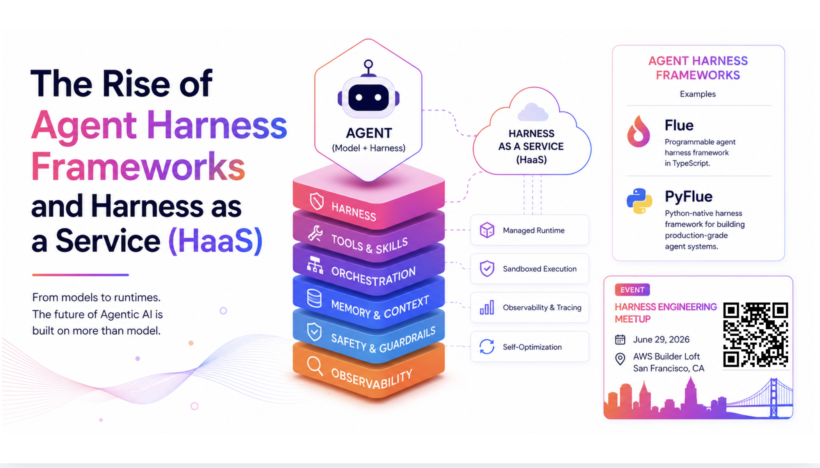
The rapid maturation of agentic AI in 2026 has shifted recently to the models to the scaffold around it. While model capabilities continue to advance, the decisive factor in building reliable, production-ready agents lies in the systems surrounding them. A capable model paired with a well-designed harness consistently outperforms a stronger model operating with inadequate scaffolding.
This insight has crystallized into a distinct engineering discipline: harness engineering. Recent contributions from industry leaders, including Addy Osmani’s comprehensive overview, and foundational work by Vivek Trivedy at LangChain, have clarified the principles and practices driving this evolution. At Superagentic AI, our ongoing research and open-source efforts in this area, including the development of PyFlue, inspired by Flue, reinforce a core conviction: the harness is no longer an afterthought. It has become the primary source of differentiation and reliability for autonomous agents.
Understanding the Agent Harness
An agent is not simply a large language model. It is a model integrated with a comprehensive runtime environment that enables purposeful action. As articulated across multiple independent blogs for industry leaders, the equation is: Agent = Model + Harness. The harness encompasses all components beyond the model itself system prompts and rule files such as AGENTS.md, tools and skills with their descriptions, orchestration logic for subagents, hooks and middleware for enforcement, sandboxes and execution environments, observability and tracing systems, memory and context management mechanisms, and recovery pathways.
This scaffolding transforms raw generative capabilities into structured, verifiable workflows. A raw model generates text. A harness equips it with state persistence, tool execution, self-correction loops, and safety boundaries so it can complete complex, multi-step tasks reliably.
The harness operates on a ratchet principle. Each observed failure leads to a permanent improvement: a new rule in the system prompt, a blocking hook before destructive commands, refined context management to combat degradation, or a split between planning and execution subagents. These adjustments accumulate, making the agent progressively more aligned with the specific demands of its environment and use case.
Failures previously attributed to model limitations often prove to be configuration opportunities. Benchmarks frequently demonstrate that the same model achieves markedly different results depending on the quality of its harness. The performance gap is not merely incremental; it frequently determines whether an agent delivers production value or remains a research prototype.
Towards Harness Engineering
Early agent development emphasized prompt design. Practitioners quickly discovered its limitations for sustained, real-world performance. Context windows fill and degrade, tools require careful integration, long-horizon tasks demand decomposition and verification, and safety concerns multiply in open environments.
Before Harness Engineering even talked about publicly, Superagentic AI released a paper SuperOpt Agentic Environment Optimization AI Agents with idea of treating entire Agent as optimisation target rather than optimizing each agent component individually, this ideas is now turning mainstream into Harness Engineering.
Harness engineering addresses these challenges systematically. It treats the runtime as a first-class, evolvable artifact rather than ad-hoc scripts. Key primitives include:
- Durable state through filesystems and version control, enabling agents to read, write, experiment, and roll back safely.
- General-purpose tooling, often via secure bash or code execution, combined with domain-specific skills.
- Sandboxes that isolate execution while providing rich defaults for testing and observation.
- Memory layers that persist lessons across sessions via structured files and searchable stores.
- Context management techniques such as compaction, offloading, and progressive disclosure to maintain reasoning quality.
- Enforcement hooks that run deterministically at critical points in the execution cycle.
- Observability and self-optimization loops that feed traces back into harness refinements.
These elements converge in mature implementations, from specialized coding agents to broader autonomous systems. The discipline draws on systems engineering traditions while adapting them to the probabilistic nature of large models.
The Emergence of Agent Harness Frameworks
Building effective harnesses from scratch for every project has become impractical. Frameworks now provide modular, battle-tested foundations so developers can focus on domain logic, custom tools, and business-specific policies.
Flue exemplifies this trend with its programmable, low-boilerplate approach in TypeScript. It offers a clean harness model that supports autonomous workflows while maintaining developer control over the full stack.
Our contribution at Superagentic AI is PyFlue, a Python-native port designed for the AI and machine learning ecosystem. PyFlue brings Markdown-driven skills, persistent sessions, policy-gated sandboxing, typed outputs, streaming events, and pluggable backends (including DeepAgents and others). Recent updates have added structured command handling, improved cancellation support, and enhanced client-server modes. It enables teams to adopt proven harness patterns without leaving their preferred language and tooling environment.
These frameworks share common strengths: opinionated yet extensible primitives, emphasis on observability, support for self-correction, and pathways to deployment. They accelerate iteration while promoting consistency. Ablation experiments and production case studies show that gains from refined orchestration, memory, and middleware often exceed those from model upgrades alone.
The community conversation, amplified by recent public discussions, highlights convergence around core patterns even as implementations vary. This maturation signals that harness frameworks are transitioning from experimental tools to foundational infrastructure.
Harness As a Service: Managed Runtimes for Agents
A parallel evolution is underway toward Harness as a Service (HaaS). Instead of assembling orchestration, tool integration, context handling, and safety layers manually, teams configure high-level runtimes that provide these capabilities out of the box.
Major providers are moving from simple completion APIs to full agent runtimes. These services handle loop management, sandboxing, observability, and basic recovery, allowing developers to concentrate on prompt strategy, tool definitions, and evaluation criteria. The shift mirrors the broader transition from infrastructure management to platform consumption, but tailored to agentic workloads.
Benefits include improved scalability, standardized observability, easier multi-agent coordination, and reduced operational burden. Challenges remain—particularly around customization depth, multi-tenancy security, and cost predictability in long-running scenarios. Nevertheless, HaaS represents a logical progression as harness patterns stabilize.
Challenges and Future Directions
Harness engineering is not without open questions. As models improve, harness needs do not vanish; they migrate upward to address more sophisticated failure modes and higher-ambition tasks. Judgment-oriented decisions, multi-agent orchestration protocols, enterprise-grade security and auditing, and dynamic tool assembly all require continued innovation.
Self-optimizing harnesses that analyze their own traces to propose or apply refinements represent a promising frontier. Interoperability standards between harnesses will become increasingly important for fleet-level agent systems. The balance between standardization and specialization will define competitive advantages.
Ultimately, harnesses function as adaptable compilers for agent behavior, translating high-level goals into reliable execution while encoding hard-won lessons from real deployments.
Conclusion
The rise of agent harness frameworks and Harness as a Service marks a pivotal maturation in agentic AI. Differentiation now stems less from raw model selection and more from the quality, adaptability, and insight embedded in the surrounding systems. Organizations that invest thoughtfully in harness engineering will deliver more reliable, maintainable, and powerful autonomous capabilities.
We continue to advance this field through open-source projects such as PyFlue and Meta-Harness initiatives, while fostering community dialogue. If you are exploring these ideas in practice, we invite you to join the conversation.
Upcoming Event on Harness Engineering
We are hosting a dedicated Harness Engineering meetup on June 29 at the AWS Builder Loft in San Francisco. This gathering will feature discussions, hands-on sessions, and practitioner insights on building production-grade agent systems. Register here.
We look forward to advancing this discipline together and welcome contributions, feedback, and collaboration from the broader community.